
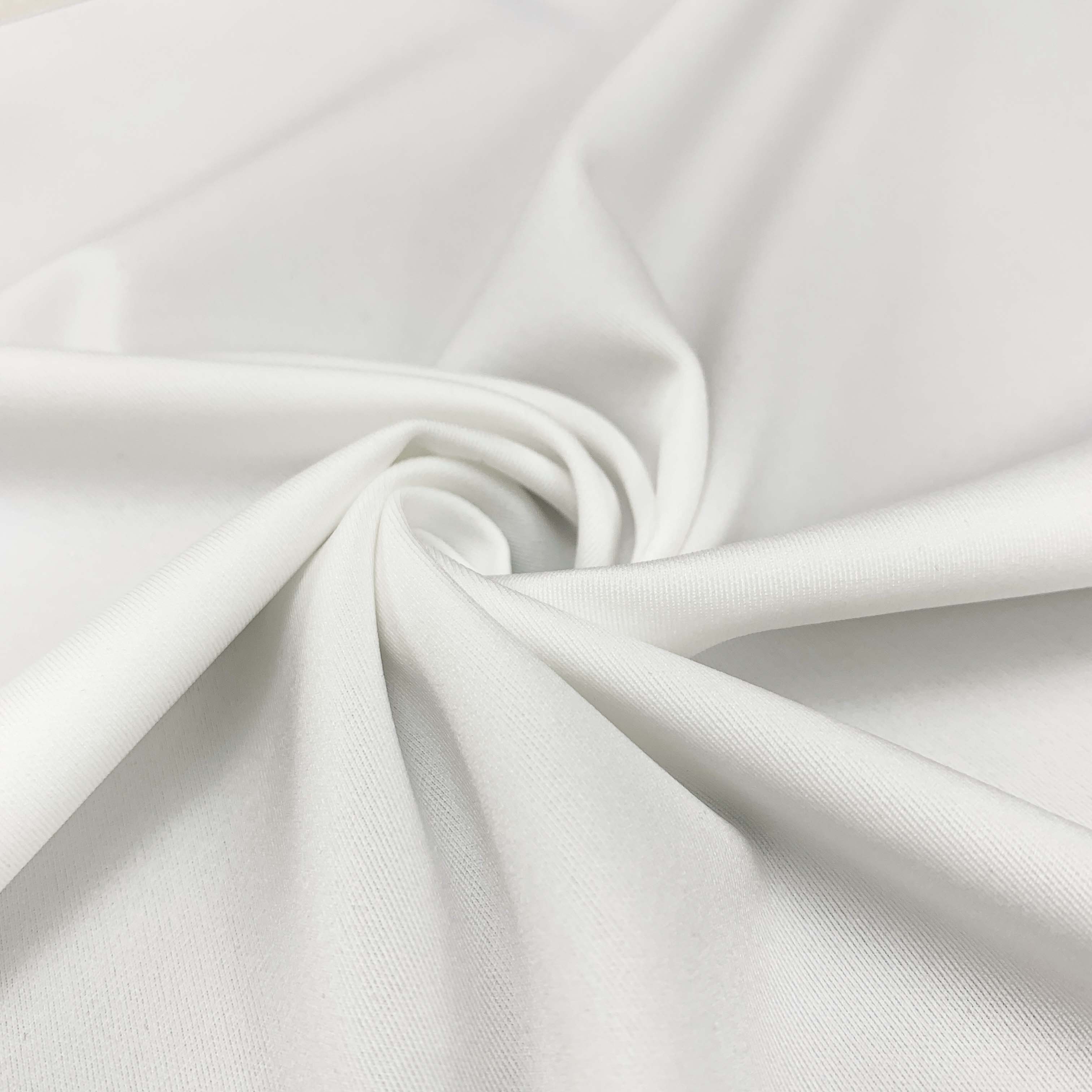
A competitive suit is not judged by how it feels on a hanger. It is judged at the 150-meter mark of a race, when the shoulders are burning and the suit has to still hold compression without riding up or going slack. That is the moment when the base fiber stops being a sourcing detail and starts being a performance variable. Nylon spandex fabric has held that position in competitive swimwear for decades, and the reasons are more specific than a generic preference for “better quality.”
What a racing suit actually demands from its fabric
Competitive swimwear sits at a strange intersection of engineering requirements. The fabric has to stretch enough for a full range of shoulder rotation, then snap back with enough force to maintain graduated compression across the torso and legs. It has to stay opaque when saturated. It has to resist chlorinated water long enough to survive a training block. And it has to do all of that without adding meaningful drag.
No single fiber delivers every property at the highest level. The blend is the product. Nylon contributes softness, dye depth, and a dense hand that knits into a smooth surface. Spandex contributes elastic memory. Change the nylon to polyester and the spandex still works, but the surrounding structure behaves differently under load and under chlorine.
Chlorine attacks spandex first, and the base fiber decides the timeline
The popular shorthand is that nylon resists chlorine and polyester does not. The reality is more precise. Chlorine degrades the spandex component in any swimwear blend, regardless of the base fiber. Standard spandex loses significant elasticity after roughly 150 to 200 hours of chlorinated water exposure, and the fabric begins to sag and fade well before the fiber visibly fails. What the base fiber controls is how the rest of the structure behaves while the spandex is under attack.
Nylon fiber is naturally more chlorine-resistant than polyester in the context of swimwear construction, which is why competitive suits from high school programs to elite racing lines are almost universally built on nylon spandex rather than polyester spandex. The advantage is not infinite. It is relative, and it narrows when chlorine-resistant spandex fibers are used in either base. A nylon/spandex blend built with a chlorine-resistant elastane can hold recovery and color far longer than a standard blend, but the base still matters for hand, compression, and color depth.
The data on degradation is blunt. Research on swimwear materials exposed to chlorinated water shows breaking force dropping by around 12 percent after 200 hours, then falling by more than 65 percent after 300 hours as fiber and yarn damage accumulates. That curve explains why a suit that feels fine in the sample room can be a different garment after a few months of daily training. The fabric was not “bad.” The exposure timeline outran the specification.
Compression is a mechanical property, and nylon delivers it with less bulk
Graduated compression is not just tightness. It is the ability of the fabric to apply controlled pressure that tapers across the body, reducing muscle vibration and supporting blood flow without restricting movement. Nylon’s finer filament structure allows knitters to build a denser, smoother surface at a given weight. That density translates into compression that feels supportive rather than merely tight.
Polyester spandex can be engineered to high compression levels, but it often gets there through heavier gauges or tighter knitting, which can stiffen the hand and reduce the natural range of motion. In a racing suit, where the shoulder and hip joints need to move through a full stroke cycle, that stiffness becomes a liability. Nylon spandex tends to hit the compression target with a lighter, more conforming structure, which is why premium racing fabrics frequently land in the 70/30 to 82/18 nylon-to-spandex range rather than a polyester-dominant blend.
| Property at equal weight | Nylon spandex | Polyester spandex |
|---|---|---|
| Stretch recovery after chlorine exposure | Higher, holds compression longer | Drops off sooner under standard spandex |
| Hand feel against wet skin | Smoother, silkier, less tacky | Firmer, can feel drier but less conforming |
| Color depth and vibrancy | Deeper dye uptake, richer tones | Good print clarity, less depth in solid colors |
| Compression per unit weight | Higher, denser knit possible | Requires heavier construction for equal support |
| Cost per yard (standard colors) | Higher | Lower |
Property comparison based on swimwear fabric mill specifications and published fabric guides; exact values shift with spandex type, knit structure, and finishing.
A production case where the sample passed but the pool did not
A teamwear supplier once developed a racing-back training suit on a nylon spandex base with a chlorine-resistant spandex. The sample passed the standard wash-cycle test and the hand was exactly what the coaching staff wanted. A small pilot batch went to a club team for a pre-season block. Within several weeks, coaches started sending back suits with the same note: the leg opening had relaxed and the suit was creeping up during flip turns.
The lab results were not a fiber failure. The spandex was still present. What had happened was that the recovery had fallen below the threshold the pattern was drafted around, and the compression zone at the leg opening lost its grip. The fix was not a more expensive spandex alone. It was a tighter knit structure at the power zones combined with a verification protocol that included chlorinated immersion cycling before bulk approval. The lesson: a nylon spandex base buys a longer performance window, but the pattern and the knit have to be validated against the actual chlorine load, not just a standard wash test.
Where nylon spandex stops being the obvious answer
Honesty matters here. Nylon spandex is not the cheapest option, and it is not the fastest-drying base fiber in every construction. Polyester has a real edge in UV-driven outdoor exposure and in sublimation printing for all-over graphics, which is why many beachwear and fashion activewear lines stay on polyester. Nylon also demands more careful dyeing and finishing to hit consistent shade depth, and those process steps add cost that shows up in the fabric quote.
For a resort suit that sees chlorinated water a handful of times a season, the performance gap may not justify the price delta. For a competitive program where the suit is in the pool five or six days a week, the economics flip. A cheaper fabric that loses compression before the season ends is not cheaper on a cost-per-use basis, especially when returns or replacement orders are factored in.
Jdttex produces nylon spandex swimwear fabrics in the 80/20 to 82/18 nylon-to-spandex range with chlorine-resistant finishing and OEKO-TEX certified material standards. For teams and brands building competitive or high-frequency training programs, that specification is the starting point, not the finish line. The knit structure, the spandex grade, and the verification protocol still decide whether the suit holds up when it matters.
Table of Contents
- What a racing suit actually demands from its fabric
- Chlorine attacks spandex first, and the base fiber decides the timeline
- Compression is a mechanical property, and nylon delivers it with less bulk
- A production case where the sample passed but the pool did not
- Where nylon spandex stops being the obvious answer