
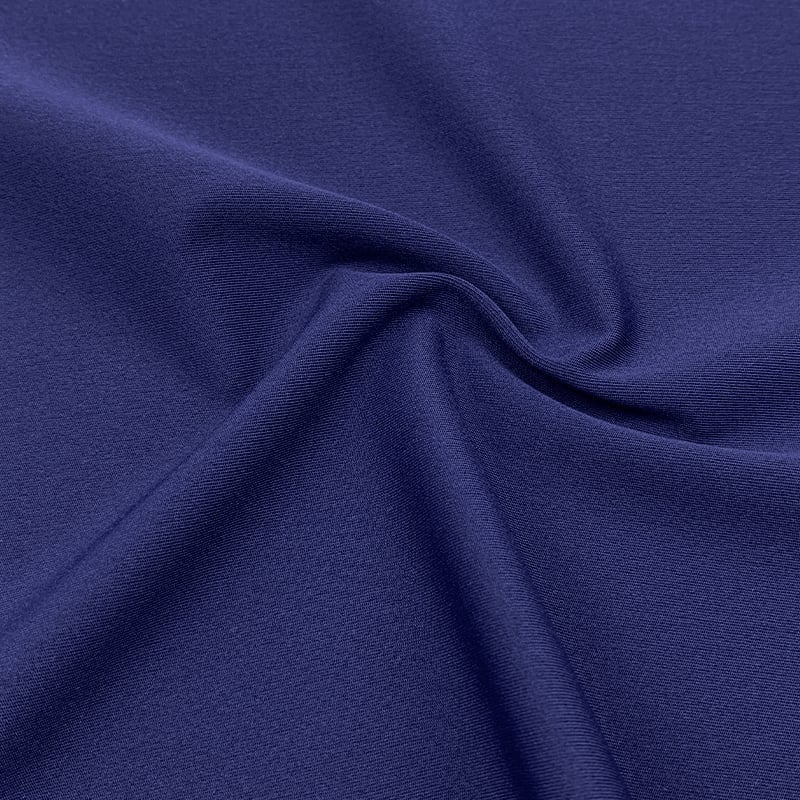
Walk into any studio and ask why a certain pair of leggings never leaves the rotation. The answer is rarely a technical spec. It is usually something closer to “they just feel right.” That feeling is not an accident. It comes from a specific fiber architecture, and in yoga wear, no blend captures it quite the same way as cotton spandex fabric.
Cotton spandex is not the fastest-drying knit on the shelf, and it will not win a compression contest against nylon spandex. What it does have is a combination of skin comfort, breathability, and natural hand feel that synthetic-dominant knits keep chasing but rarely fully replicate. Understanding where that advantage comes from, and where it quietly stops working, is the difference between a fabric that sells once and one that becomes a repeat purchase.
The feel advantage starts at the fiber level, not the finish
Most performance knits rely on filament yarns, which are continuous strands extruded to a specific denier. Filament yarns are strong, uniform, and excellent at moving moisture, but they are also inherently smooth in a way that can read as “slick” against skin. Cotton is a staple fiber. It is spun from shorter lengths that overlap and twist, and that spun structure creates microscopic irregularity at the surface. The result is a fabric that touches the skin with a soft, slightly dry hand rather than a cool, gliding one.
That difference matters in yoga specifically because the practice is low-impact and often bare-skin. A hot yoga session will push any fabric hard, but a vinyasa flow or a restorative class involves sustained skin contact, seated postures, and a body that is moving slowly enough to notice texture. Cotton spandex leans into that context. It feels like a second layer of softness rather than a technical shell. Spandex content in these blends is typically modest, often in the 5 to 10 percent range, which is enough to give the knit four-way stretch and recovery without turning the fabric into a compression garment.
Breathability is the benefit most synthetic knits cannot honestly claim
Air permeability is measured under standard test methods such as ASTM D737, and the general pattern across knit structures is consistent: cellulosic and cotton-rich knits tend to allow more air movement than tightly constructed synthetic knits at similar weights. That matters less for a hard training session and more for the way yoga is actually practiced. A room-temperature flow class does not generate the sweat load of a spin class. The body needs ventilation more than it needs aggressive wicking.
Cotton’s breathability is passive. It does not push moisture away through capillary channels the way engineered polyester does. Instead, the fiber absorbs moisture into its structure and allows it to evaporate from the fabric surface over time. For low-to-moderate sweat output, that mechanism works well enough, and it avoids the clingy, damp-plastic feeling that some synthetic knits develop when they approach saturation. The trade-off is real and worth naming: once sweat output climbs high enough, cotton holds water and gets heavy. A cotton spandex blend is comfortable in a warm flow class; it is not the fabric to choose for a 90-minute hot yoga session where the body is pouring sweat from the first sun salutation.
| Property | Cotton spandex (typical 5–10% spandex) | Synthetic-dominant knit (nylon or polyester spandex) |
|---|---|---|
| Hand feel against dry skin | Soft, dry, natural | Smooth, cool, sometimes slick |
| Breathability at rest and low exertion | High | Moderate, structure-dependent |
| Moisture transport under heavy sweat | Absorbs and holds, slower to dry | Wicks and spreads, faster dry |
| Compression and sculpting | Low to moderate | Moderate to high |
| Pilling risk | Depends heavily on cotton staple length | Lower with filament yarns, but not zero |
| Shrinkage risk | Present unless pre-shrunk or stabilized | Generally lower |
The pilling question is a cotton quality question, not a blend failure
Cotton spandex has a reputation for pilling, and that reputation is partly earned and partly misdiagnosed. Pilling happens when loose fiber ends work their way out of the yarn and tangle into small balls under friction. Staple fibers have more ends per unit length than filament fibers, so cotton is naturally more prone to it than nylon or polyester filament. But the variable that separates a pill-prone cotton blend from a durable one is staple length.
Short-staple cotton, common in commodity yarns, has many fiber ends close to the surface. Long-staple cotton, such as Pima or Supima types, has fewer exposed ends per square inch and resists pilling noticeably better. A cotton spandex knit built on a long-staple yarn will wear very differently from a cheaper blend that looks identical on the sample table. The spandex percentage is almost secondary to that fiber decision. A common mistake in sourcing is to treat all cotton spandex as interchangeable and negotiate only on price per yard. The fiber length inside the yarn is doing more work than the price tag reveals.
A leggings program that learned the hard way about fiber spec
A small athleisure label once built a core cotton spandex legging around a competitively priced knit. The first samples passed a basic wash test and the hand feel was exactly what the design team wanted. Bulk production shipped, and the first customer feedback cycle brought a familiar complaint: visible pilling between the thighs after a handful of wears. The fabric had not failed in the lab. It had failed in friction zones that the initial test protocol did not stress.
The fix required going back to the yarn, not the finish. The replacement fabric moved to a long-staple cotton base with a slightly higher spandex percentage for better recovery at the crotch and inner thigh, and the brand added a Martindale abrasion check and a pilling resistance test to its approval protocol before the next drop. The new fabric cost more per yard. The return rate told a different story about which fabric was actually cheaper. That experience is a useful reminder: cotton spandex is a category, not a single specification, and the difference between a good and bad version lives in decisions made before the knitting machine ever runs.
Shrinkage and recovery are manageable, but they need to be engineered in
Cotton is a hydrophilic fiber. It swells when wet, and the internal stresses from spinning and knitting can release during laundering, which is why cotton-rich knits are prone to shrinkage if the fabric is not properly prepared. Spandex helps with recovery, but it does not prevent the cotton component from moving. A cotton spandex blend that has not been pre-shrunk, compacted, or heat-set with dimensional stability in mind will lose length and width after the first few washes.
This is a finishing problem more than a fiber problem. Tenter-frame heat setting and controlled compaction can stabilize the knit, and a pre-shrunk cotton spandex can hold its dimensions through repeated home laundering at moderate temperatures. The caveat is that stabilization adds cost and requires a mill that understands the interaction between cotton’s swelling behavior and spandex’s elastic memory. A fabric that skips those steps may look fine in the roll and behave differently after the first wash. Buyers who specify a shrinkage tolerance, typically expressed as a percentage of original dimensions after a defined wash cycle, get a more predictable garment than those who rely on the mill’s default finish.
Where cotton spandex stops making sense, and what to choose instead
Honesty about limits is part of a useful specification. Cotton spandex is not the right base for hot yoga, high-sweat training, or any application where the garment needs to stay light and dry under continuous heavy moisture load. For those use cases, nylon spandex or engineered polyester spandex will outperform it on moisture transport and recovery under saturation. Cotton spandex is also not a compression fabric in the way that a high-spandex nylon knit is. It supports and stretches, but it does not sculpt.
The applications where it earns its place are specific: restorative and slow-flow yoga, casual studio-to-street leggings, lounge and recovery wear, and any product where the customer is buying comfort as a primary feature rather than performance under stress. It is also a strong choice for sensitive-skin wearers, because cotton’s natural surface and moisture absorption reduce the clammy sensation that some synthetic knits produce during low-exertion wear. Matching the fiber to the class type, rather than forcing one knit across an entire range, is the more reliable path to fewer returns.
Jdttex runs yoga and sports knit development through an integrated knitting, dyeing, and finishing setup, with OEKO-TEX Standard 100 and GRS certifications covering cotton and elastane constructions. For brands building a cotton spandex program, that means the fiber spec, the stabilization finish, and the pilling protocol can be aligned before bulk, which is exactly where the difference between a comfortable sample and a durable garment is decided.
Table of Contents
- The feel advantage starts at the fiber level, not the finish
- Breathability is the benefit most synthetic knits cannot honestly claim
- The pilling question is a cotton quality question, not a blend failure
- A leggings program that learned the hard way about fiber spec
- Shrinkage and recovery are manageable, but they need to be engineered in
- Where cotton spandex stops making sense, and what to choose instead