
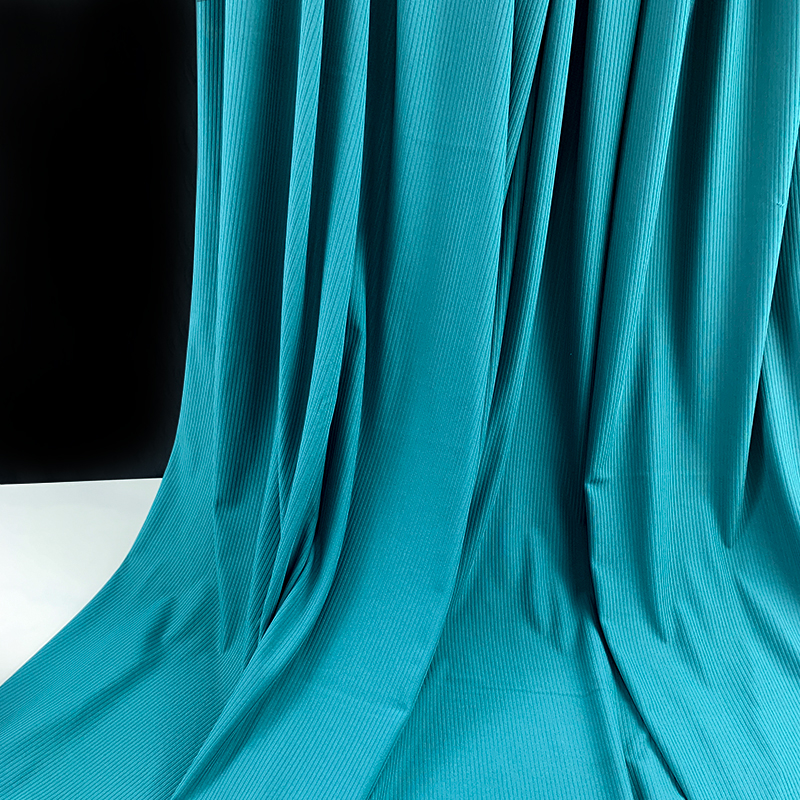
What Makes Nylon Spandex the Default Choice for Stretch-Print Applications
Nylon spandex fabric occupies a specific and demanding niche. It is the material that performance swimwear, dancewear, and activewear brands turn to when the garment has to stretch in multiple directions, hold its shape through repeated wear, and display a print with clarity and color depth. The combination of properties is not easy to replicate with other fiber blends, which is why nylon spandex has maintained its position despite the availability of cheaper alternatives.
The core advantage is in the fiber pairing. Nylon contributes strength, abrasion resistance, and a smooth surface that accepts dye and ink well. Spandex contributes elasticity and recovery. Together, they produce a fabric that can be stretched repeatedly without permanent deformation, printed with intricate designs, and washed without losing its color vibrancy or its fit.
For brands sourcing wholesale nylon spandex with custom prints, the challenge is not finding the material. It is finding a supplier that can deliver consistent print quality, reliable color matching, and a production timeline that aligns with the brand’s market windows.
The Print Technologies That Work Best on Nylon Spandex
Not all printing methods perform equally on nylon spandex. The choice of print technology affects color vibrancy, hand feel, durability, and cost.
Digital sublimation printing is the most common method for polyester-based stretch fabrics, but it does not work well on nylon because nylon does not accept disperse dyes in the same way. For nylon spandex, acid dye printing is the standard approach. Acid dyes have an affinity for nylon’s polymer structure, producing deep, vibrant colors with good wash fastness.
Digital acid printing has advanced considerably in recent years. Modern digital acid printers can achieve fine detail and smooth gradients on nylon spandex, rivaling the quality of rotary screen printing for many applications. The advantage of digital is flexibility: no screens, no minimum quantities per design, and fast turnaround from artwork to production.
For brands that need larger volumes of a single print, rotary screen printing remains cost-competitive and offers excellent color consistency across a production run. The trade-off is the setup cost and the minimum order quantity, which typically starts in the hundreds of meters per design.
| Print Method | Best Suited For | Typical Minimum | Color Vibrancy | Hand Feel Impact |
|---|---|---|---|---|
| Digital acid printing | Small batches, complex designs | 50–100 meters | High | Minimal |
| Rotary screen printing | Large batches, simple repeats | 300–500 meters | Very high | Slight stiffening |
| Digital pigment printing | Blended fabrics, quick turnaround | 20–50 meters | Moderate | Can be noticeable |
| Dye sublimation | Polyester spandex only | N/A for nylon | Very high | Minimal |
Specifying Nylon Spandex Fabric for Print Performance
The base fabric specification determines how well the print will perform. Several parameters matter most.
Fiber composition and spandex content: A typical nylon spandex blend for printed activewear or swimwear runs from 78% to 82% nylon and 18% to 22% spandex. Higher spandex content increases stretch and recovery but can also affect print registration because the fabric moves more during printing.
Fabric weight: Nylon spandex for printed applications typically falls in the 180 to 260 GSM range. Lighter weights are more suitable for swimwear and summer activewear, while heavier weights provide more coverage and a more substantial hand feel for compression garments.
Surface texture: A smooth, flat surface produces the sharpest print detail. Brushed or peached surfaces can create a softer hand feel but may reduce print sharpness. This is a design trade-off that should be decided based on the intended garment.
Stretch direction: Four-way stretch is standard for nylon spandex. The print design should be tested at the fabric’s maximum stretch to ensure that fine details do not distort in wear.
Color fastness requirements: For swimwear and activewear that will be exposed to chlorine, salt water, and frequent washing, color fastness is a critical specification. Standards such as ISO 105 and AATCC 61 provide testing protocols that allow suppliers to be compared on measurable criteria rather than visual judgment alone.
The Sampling Process That Prevents Expensive Mistakes
Custom printed nylon spandex involves two overlapping variables: the fabric and the print. Both need to be validated before bulk production, and the sampling process should be structured to isolate issues.
A practical sampling sequence looks like this:
Base fabric approval: Confirm the fabric’s weight, stretch, recovery, and hand feel on a plain dyed sample before introducing print variables.
Lab dip for color: For solid colors or print backgrounds, a lab dip confirms that the supplier can match the target color on the specified base fabric.
Strike-off for print: A strike-off is a small-scale print sample that shows how the design translates onto the actual fabric. This is where print scale, registration, and color accuracy are evaluated.
Print durability testing: Wash the strike-off sample using the intended care instructions and evaluate color retention, print adhesion, and hand feel after washing.
Wear trial: If possible, construct a garment from the approved sample fabric and test it in real wearing conditions before committing to bulk.
The sequence matters because each step builds on the previous one. Approving a print on a base fabric that later proves unsuitable for the garment’s construction requirements is a waste of time and money.
A Sourcing Story From the Swimwear Sector
A swimwear brand based in Southern California was preparing a resort collection and had selected a digital acid print on a 200 GSM nylon spandex fabric. The strike-off looked excellent, with rich color and sharp detail. The brand approved the print and placed a bulk order for 800 meters across two colorways.
The bulk fabric arrived on schedule, but the print registration was visibly off on one of the colorways. The design elements that should have aligned at the seams were misaligned by several millimeters. The supplier explained that the fabric had been printed on a different machine with a slightly different tension profile, which had affected the print registration.
The brand was able to salvage the order by adjusting the garment patterns to accommodate the offset, but it required re-cutting and re-sewing a significant portion of the production run. The lesson was that print approval and bulk print approval should be separate steps, ideally with a bulk production sample pulled from the actual production line before the full run is printed.
Why Supply Chain Consistency Matters More Than Price Per Meter
In nylon spandex sourcing, the lowest quoted price per meter is rarely the lowest total cost. The variables that drive total cost are print consistency, color matching accuracy, delivery reliability, and the cost of dealing with defects or delays.
A supplier that quotes a slightly higher price but maintains consistent quality across batches is almost always the better choice for a brand that cannot afford to re-cut a production run or explain a color discrepancy to retail buyers. The swimwear example above illustrates the principle: the cost of the print registration issue far exceeded whatever savings the supplier’s lower quote may have represented.
This is why supplier evaluation should go beyond price comparison. Requesting production samples from previous orders, asking for references from comparable brands, and visiting the production facility if feasible are all standard practices for brands that source nylon spandex at volume.
How Jiadatai Textile Supports Printed Nylon Spandex Development
JDTTEX, trading as Jiadatai Textile, operates a knitting, printing, and dyeing facility in Dongguan that is set up for exactly this kind of development work. The company’s capabilities include digital and rotary printing on stretch fabrics, with in-house knitting that allows the base fabric and the print to be developed as an integrated system rather than as separate components sourced from different suppliers. For brands sourcing wholesale nylon spandex with custom prints, the combination of integrated production, free sampling, and flexible minimum order quantities offers a practical path from concept to bulk. The company’s focus on eco-conscious material development and trend guidance adds a layer of support that is particularly useful for brands navigating the intersection of performance requirements and sustainability expectations.
Table of Contents
- What Makes Nylon Spandex the Default Choice for Stretch-Print Applications
- The Print Technologies That Work Best on Nylon Spandex
- Specifying Nylon Spandex Fabric for Print Performance
- The Sampling Process That Prevents Expensive Mistakes
- A Sourcing Story From the Swimwear Sector
- Why Supply Chain Consistency Matters More Than Price Per Meter
- How Jiadatai Textile Supports Printed Nylon Spandex Development