
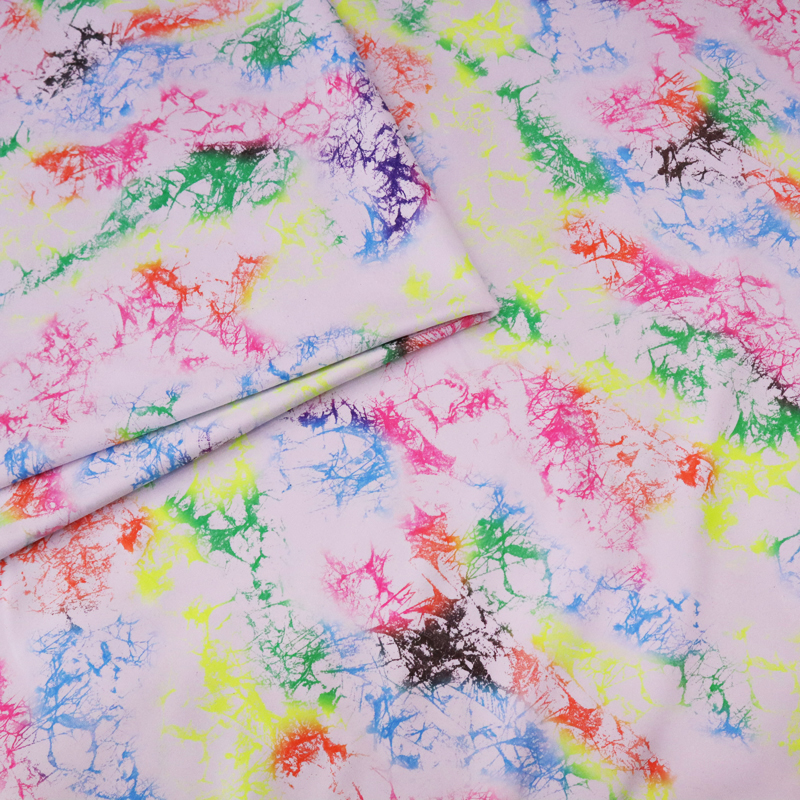
Why Off-the-Shelf Prints Keep Brands Stuck in the Same Crowd
Walk through any trade show or scroll through a fashion marketplace, and a pattern becomes obvious. The same geometric prints, the same botanical motifs, the same color-blocked designs show up on brand after brand. That sameness is not a coincidence. It comes from sourcing off-the-shelf printed fabric, where thousands of labels draw from the same limited pool of stock designs.
The numbers tell a story of rapid change. Custom printed textile demand grew 31% between 2022 and 2025, and the average print run size dropped from roughly 2,500 units in 2018 to around 900 units by 2025. Brands that once ordered in bulk from stock catalogs are now commissioning their own prints, often in smaller batches. That shift is not just about aesthetics. It is about survival in a market where consumers can compare hundreds of options in seconds.
Custom print fabric, when done right, gives a brand something no stock print can offer: a visual identity that cannot be copied overnight. The mechanics behind that shift are worth unpacking, from the economics of short runs to the technical decisions that determine whether a print actually holds up on the shelf.
The Real Reason Custom Print Runs Keep Getting Smaller
Not long ago, the economics of textile printing pushed brands toward volume. Screen printing required engraved cylinders, one for each color, and those cylinders cost real money. Four colors meant four cylinders, and that setup cost only made sense if the run was long enough to amortize it.
Digital printing changed the math. With inkjet technology, the design lives in a file, not on a metal cylinder. A 12-color botanical print costs no more to set up than a two-color stripe. That single change unlocked something the industry had been talking about for years but could rarely deliver: short runs that make commercial sense.
The market responded fast. Digital textile printing grew from $3.85 billion in 2025 to an estimated $4.43 billion in 2026, with a projected reach of $7.59 billion by 2030. Adoption rates jumped from 18% in 2020 to 35% in 2025, and the trajectory points toward 52% by 2030. Those numbers reflect a structural shift, not a temporary trend.
| Printing Method | Typical Minimum Order | Setup Cost | Best Fit |
|---|---|---|---|
| Digital (reactive ink) | 50–100 meters | Minimal | Complex designs, market testing |
| Flat-bed screen | 800–1,500 meters | $200–$500 per screen | Placement and panel prints |
| Rotary screen | 1,500–3,000 meters | $300–$800 per color | Proven designs, long repeats |
That table explains why a brand testing a new print concept can now order a few hundred meters instead of committing to thousands. The risk drops, and the willingness to experiment goes up.
What a Custom Print Actually Does for Brand Recognition
A print that belongs to one brand functions as a signature. Think of how certain luxury houses are identified by their tweeds or their monogram patterns. The textile itself becomes shorthand for the brand. That kind of recognition does not happen with stock fabric, because the same print can appear on a competitor's product the following season.
There is a practical dimension too. When a brand develops its own print, it controls the color story, the repeat size, the hand feel of the base cloth, and the finish. Those variables combine to create a product that feels deliberate rather than assembled. Consumers may not articulate why one garment feels more considered than another, but they register the difference.
The market data supports this. Fashion and apparel account for 42% of total printed textile demand, and the segment consumed over 4.8 billion square meters of printed fabric in 2025 alone. Within that volume, the brands growing fastest are the ones treating fabric as a design decision rather than a procurement line item.
One pattern worth noting: brands that develop custom prints often see stronger repeat purchase behavior. The print becomes part of the product's identity, and customers return for that specific visual signature. It is a slow-building asset, not a quick win, but it compounds over seasons.
Sustainability Is No Longer a Separate Conversation
The environmental case for digital custom printing is straightforward, but it is worth being precise about where the gains actually come from. Digital printing uses up to 70% less water than conventional methods and generates roughly 30% less chemical waste. Those reductions are real, and they come from eliminating the washing and steaming steps that screen printing requires.
But sustainability in custom printing goes beyond the printing process itself. The more significant impact often comes from producing closer to actual demand. When a brand prints 300 meters of a new design instead of 3,000 meters of a speculative one, the unsold inventory problem shrinks. Deadstock is one of the least discussed environmental costs in fashion, and custom printing directly addresses it.
Certifications matter here too. The Global Recycled Standard (GRS) verifies recycled content through the production chain and adds social and environmental requirements on top. OEKO-TEX Standard 100 addresses chemical safety. For brands making sustainability claims to consumers, these certifications provide third-party verification rather than self-declaration. It is worth asking a printing partner which certifications they actually hold and how those are documented per order.
The honest limitation: digital printing is not automatically sustainable. Ink chemistry varies, energy consumption depends on the equipment, and the base fabric still has its own footprint. Custom printing reduces waste and water use, but it does not make a product carbon-neutral. Brands that communicate honestly about this tend to earn more trust than those that overstate the case.
When Custom Print Goes Wrong and How to Avoid It
A custom print project can fail in ways that are not obvious until the fabric arrives. Color matching is the most common problem. A digital file viewed on a monitor will not look the same when printed on cotton versus polyester, or on a matte finish versus a glossy one. The substrate changes everything.
A case from a swimwear brand illustrates this well. The design team approved a vibrant coral print based on a screen preview. When the first strike-off arrived on a nylon-spandex base, the coral read noticeably duller because the fabric's sheen absorbed light differently than the reference material. The fix was not complicated, a slight adjustment to the ink formulation, but it required a printing partner willing to run a second strike-off before committing to the full order. That kind of back-and-forth is normal in custom printing, and brands that skip it often end up with inventory they cannot sell.
The lesson is practical: always request a physical strike-off on the actual base fabric before approving a bulk run. Digital workflows make this faster and cheaper than it used to be, but the step cannot be skipped.
Another failure point is repeat size. A print that looks balanced on a small swatch can feel overwhelming when scaled to a full garment panel. Testing the repeat on the actual pattern piece, not just a flat swatch, catches this early.
Choosing a Print Partner Without Getting Burned
The printing partner matters as much as the design. A factory that treats custom print as an add-on service will produce different results than one where printing is part of an integrated production flow. The difference shows up in consistency, lead times, and how problems get handled when they arise.
Questions worth asking before committing: Does the partner have in-house knitting and dyeing, or do they outsource base fabric? Can they produce a strike-off on the exact base cloth that will be used for bulk? What is their process for color approval, and how many rounds are included? How do they handle a print that does not match the approved standard?
The answers reveal whether a supplier is set up for custom work or just tolerating it. A vertically integrated operation, where knitting, printing, and dyeing happen under one roof, tends to catch issues earlier and respond faster. That integration is not a guarantee of quality, but it removes a layer of coordination risk that often causes delays.
Jdttex operates this kind of integrated model. Its knitting, printing, and dyeing capabilities sit within a single production chain, which supports custom print development from initial sampling through bulk production. For brands exploring custom printed fabric as a differentiation strategy, that structure reduces the friction between design intent and finished roll. Free sample and consulting services are available for brands that want to test the process before committing.
Table of Contents
- Why Off-the-Shelf Prints Keep Brands Stuck in the Same Crowd
- The Real Reason Custom Print Runs Keep Getting Smaller
- What a Custom Print Actually Does for Brand Recognition
- Sustainability Is No Longer a Separate Conversation
- When Custom Print Goes Wrong and How to Avoid It
- Choosing a Print Partner Without Getting Burned