
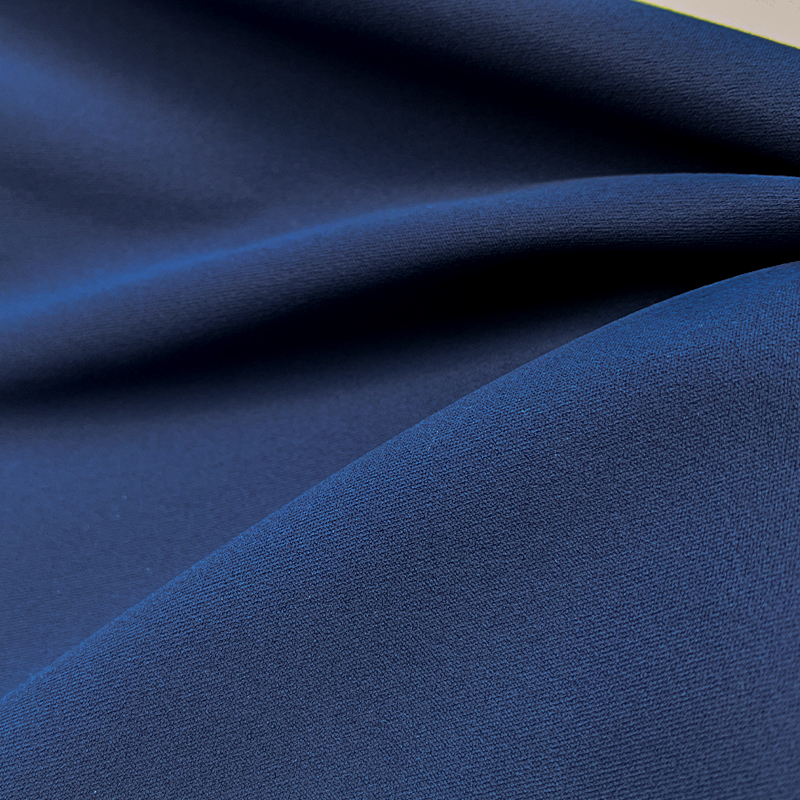
Nylon spandex fabric gets specified for one reason above all others: it snaps back. Spandex alone can stretch several times its original length, but it needs a partner to carry structural load and resist abrasion. Nylon supplies that backbone, with high tensile strength, a smooth hand, and enough durability to survive repeated washing and wear. The pairing shows up across a wide band of fiber ratios, from 80/20 nylon-elastane workhorses to 70/30 and even 65/35 constructions pushed by competitive swimwear brands for maximum compression. What changes between those ratios is not whether the fabric stretches, but how firmly it holds a shape and how quickly it returns after the stretch is released.
Why Stretch Recovery Is the Real Performance Metric
Garment makers talk about stretch percentage because it photographs well on a spec sheet. Recovery matters more in the wearing. A fabric that extends easily but creeps forward after twenty minutes of movement leaves bagged knees, sagging seats, and a silhouette that looks tired by lunch. ASTM D3107 is the standard test method used to measure fabric stretch, growth, and recovery after a specified tension and extension, and it exists precisely because those properties predict what a garment will do in use rather than just in a lab. Nylon contributes to recovery by resisting deformation at the fiber level, while spandex provides the elastic engine. When the ratio tips too far toward spandex, the fabric can feel rubbery and lose dimensional stability. When spandex drops below roughly 10%, recovery weakens and the garment starts to bag out sooner.
Where Nylon Spandex Actually Shines: Movement-Intensive Apparel
The clearest applications sit where the body is in constant motion and the garment has to follow without restriction. Yoga leggings, training tights, compression tops, cycling shorts, and dancewear all lean on the same combination of four-way stretch and fast recovery. A 72/28 nylon-spandex knit delivers a close, supportive fit without feeling locked down, and the nylon surface resists the pilling and fuzzing that plague lower-grade stretch fabrics after repeated abrasion. The fabric also takes dye and print exceptionally well, which matters for brands that treat leggings and sports bras as color-driven fashion items rather than pure utility pieces.
Swimwear Is a Different Beast, and Nylon Spandex Knows It
Pool and ocean use puts nylon spandex in a harsher environment than any gym session. Chlorinated water attacks polyamide and elastane over time, and prolonged exposure can cause progressive loss of strength and elasticity. Research on swimwear degradation has documented significant tensile loss after extended chlorine contact, with nylon degradation accelerating at lower pH levels. That limitation is real and should not be glossed over. Still, nylon spandex remains a dominant swim fabric because the blend delivers a streamlined, body-hugging fit with the recovery needed to hold shape through repeated laps. The practical answer is not to pretend chlorine resistance is unlimited, but to specify the right nylon quality, rinse after use, and avoid leaving suits damp in a bag.
| Application | Typical Nylon/Spandex Range | Why the Blend Fits | Honest Limitation |
|---|---|---|---|
| Yoga and training leggings | 72/28 to 80/20 | Four-way stretch, recovery, smooth surface | Heat sensitivity in dryer |
| Competitive and recreational swimwear | 70/30 to 80/20 | Compression, shape retention, quick dry | Chlorine degrades nylon and spandex over time |
| Shapewear and support undergarments | 54/46 to 72/28 | Firm compression with snap-back recovery | Higher spandex raises cost and heat sensitivity |
| Cycling and triathlon shorts | 78/22 to 82/18 | Abrasion resistance, muscle support | Fit must be tuned to avoid seam pressure |
The Breathability Question Deserves a Straight Answer
Nylon is not a naturally breathable fiber, and a dense nylon spandex knit can trap heat if the construction is wrong. Modern knitting and finishing can improve the picture by engineering channels for air movement and wicking sweat away from skin, but the starting point is less favorable than cotton or modal. That makes nylon spandex a poor default for hot, humid, low-activity everyday wear. Where it earns its keep is in garments that are worn hard and washed often, where durability and recovery outweigh the breathability penalty. For a summer casual brief or a sleep short, the blend is usually the wrong tool. For a compression layer or a swimsuit, it is often the only tool that holds up.
A Production Floor Lesson: The Ratio Looks Fine Until the Wear Trial
During a seamless cycling short development run, the first samples passed stretch and recovery testing on the lab bench. Wear trials told a different story. Riders reported the short creeping upward at the thigh after thirty minutes in the saddle, despite the fabric meeting its recovery spec in a single pull test. The issue was not the spandex percentage itself but the heat-setting profile. Spandex needs controlled thermal stabilization to relieve tension at a lower denier and hold recovery over repeated extension cycles. Adjusting the heat-set temperature and dwell time, then re-testing recovery after multiple stretch cycles rather than one, solved the creep. The lesson applies broadly: nylon spandex is forgiving in a swatch and unforgiving in a wear trial if the finishing recipe is not matched to the garment's motion pattern.
Matching the Blend to the Job
Nylon spandex is not a universal fabric, and treating it as one leads to disappointment. It is the right choice for close-fitting, movement-heavy garments that demand recovery and abrasion resistance. It is the wrong choice for breathable everyday basics in hot climates. The ratio, knit density, and finishing profile all need to align with the end use, and the honest limitations around chlorine exposure and heat sensitivity should be planned for rather than discovered after a season of returns.
Jdttex operates as a full-vertical knit supplier with in-house knitting, dyeing, digital printing, and functional finishing, which keeps nylon spandex constructions consistent from sample through bulk. For brands building yoga, swim, or compression programs, that control over the finishing stage is often where recovery performance is won or lost.
Table of Contents
- Why Stretch Recovery Is the Real Performance Metric
- Where Nylon Spandex Actually Shines: Movement-Intensive Apparel
- Swimwear Is a Different Beast, and Nylon Spandex Knows It
- The Breathability Question Deserves a Straight Answer
- A Production Floor Lesson: The Ratio Looks Fine Until the Wear Trial
- Matching the Blend to the Job