
Why the Polymer Backbone Dictates Hand-Feel From Day One
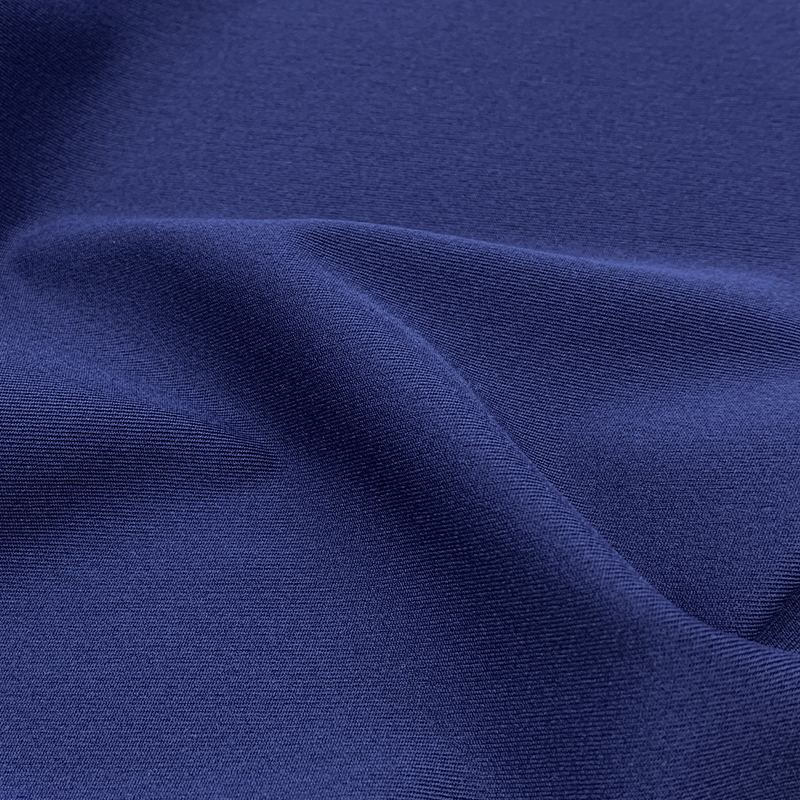
Touch a rack of high-end yoga leggings, seamless intimates, or premium rash guards, and the difference between polyamide and cheaper synthetics is obvious within two seconds. While polyester often carries a slightly crisp, papery, or plastic-like edge unless heavily brushed, nylon spandex fabric feels naturally buttery, cool, and liquid against the skin right off the knitting machine.
That tactile advantage starts at the molecular level. Nylon, known technically as polyamide (most commonly Nylon 6 or Nylon 6,6 in apparel), features repeating amide groups connected by flexible aliphatic carbon chains. Unlike polyester, which packs rigid aromatic benzene rings into its polymer backbone, polyamide lacks those stiff ring structures. Its initial modulus of elasticity is noticeably lower, meaning the individual filaments bend and flex under the slightest pressure from human fingertips rather than pushing back.
Thermodynamics also play a huge role in how a garment feels the moment a customer pulls it on in a fitting room. Nylon has a higher thermal conductivity and a moisture regain of roughly 4.0% to 4.5% under standard atmospheric conditions. That small library of bound water molecules inside the fiber acts as a thermal sink, drawing heat away from the epidermis and creating an instant cooling sensation. When blended with 15% to 25% elastane, the polyamide loops hug the skin closely enough to maximize this heat transfer while draping like a second skin.
Micro-Denier Spinning and Mechanical Abrasion Resistance
In the textile world, softness and toughness usually fight each other. Brushing a cotton fleece or modal jersey makes it plush, but it also weakens the yarn surface and invites rapid pilling. Polyamide breaks that rule by pairing low bending rigidity with the highest abrasion resistance of any common apparel fiber.
The secret lies in strong intermolecular hydrogen bonding between adjacent amide linkages. When an athlete's thighs rub together during a marathon, or when a warehouse worker's base layer scrapes against a lifting belt, nylon filaments do not snap and splinter into sharp fiber ends. Instead, the polyamide chains absorb the kinetic energy, deform elastically, and slide past the friction point.
During a recent fabric sourcing audit for a European coastal swimwear and studio activewear label, product developers tried to solve a recurring customer complaint: their existing 220 GSM brushed polyester-elastane tights were pilling along the inner thigh seam after just five studio sessions. Lab testing under ISO 12945-2 (Martindale Pilling Test) showed the brushed polyester dropping to Grade 2.5 after 2,000 rubs because broken micro-fibers were tangling into stubborn fuzz balls. The engineering team switched the specification to a 40-gauge double-knit interlock using 40D/34F Nylon 66 air-textured yarn plated with 30D elastane at 215 GSM. Without any mechanical brushing that cuts into filament integrity, the unbrushed micro-nylon achieved a suede-like hand-feel purely through fine filament count (less than 1.2 denier per filament) and held a solid Grade 4.5 pilling rating past 10,000 Martindale cycles.
Lab-Tested Performance Metrics Across Competing Elastic Knits
Sourcing teams evaluating materials for dancewear, medical compression sleeves, cycling bibs, or everyday loungewear need hard numbers to justify the raw material premium of polyamide over standard polyester or regenerated cellulose blends.
| Testing Parameter | 80% Nylon / 20% Spandex | 80% Polyester / 20% Spandex | 92% Modal / 8% Spandex |
|---|---|---|---|
| Dry Tenacity (Grams per Denier) | 4.5 to 5.8 g/d | 4.0 to 5.0 g/d | 2.2 to 2.6 g/d |
| Martindale Abrasion Resistance (ASTM D4966) | 40,000 to 60,000+ cycles | 25,000 to 35,000 cycles | 8,000 to 12,000 cycles |
| Moisture Regain at 65% RH (ASTM D1909) | 4.0% to 4.5% | 0.4% to 0.5% | 11.0% to 12.5% |
| Bending Rigidity (KES-FB2 Shear/Bend) | Very Low (buttery drape) | Moderate (springy hand) | Extremely Low (limp drape) |
| Acid Dye Uptake and Depth of Shade | Deep, vibrant, neon-capable | Requires high-temp disperse dyes | Reactive dyes (prone to wet crocking) |
As the lab benchmarks confirm, modal-spandex feels wonderful in a bedroom tee but falls apart under friction and holds nearly twelve percent of its weight in water. Polyester-spandex dries fast and costs less, yet it cannot match the sheer tensile toughness or low-friction glide of a polyamide-elastane knit.
Selecting the Right Knitting Gauge and Nylon Type for Specific Apparel
Not every nylon spandex fabric behaves the same way on a cutting table, and specifying "80/20 nylon spandex" on a purchase order without defining the polymer type or knitting construction is a recipe for bulk production surprises. Technical designers generally separate polyamide-elastane developments into three distinct categories:
Warp-knitted tricot (18% to 25% spandex with dull or shiny Nylon 6): Built on high-speed warp knitting machines (28 to 36 gauge), tricot is virtually run-proof. If a sharp surfboard fin or fingernail punctures the cloth, the interlocking vertical loops stop the hole from laddering. This makes warp-knitted polyamide the gold standard for swimwear, triathlon suits, and orthopedic braces.
Circular double-knit interlock (20% to 28% spandex with supplex or air-jet textured Nylon 66): Knitted on ultra-fine 40-gauge to 50-gauge circular machines, interlock hides the elastomeric yarn completely inside the core between two faces of polyamide. The result is squat-proof opacity, zero shiny "grin-through" when stretched over the knees, and reversible smoothness for luxury leggings and equestrian breeches.
Lightweight single jersey (8% to 14% spandex with micro-denier Nylon 6): Ranging from 130 to 170 GSM, this breathable, fluid construction is widely used for seamless underwear, golf polos, and summer commuter shirts where four-way stretch and cool-touch comfort matter more than heavy compression.
Real-World Limitations in Chlorine, Sunlight, and Drying Speed
Anyone who tells a buyer that polyamide-elastane has zero weaknesses has never read a textile testing failure report. For all its strength against mechanical friction, the amide linkage in nylon is chemically vulnerable to oxidation and photodegradation. Left out under harsh midday ultraviolet rays or soaked repeatedly in chlorinated pool water, unprotected nylon chains break down, lose tensile strength, and turn yellow, while standard elastane filaments snap and turn mushy. Swimwear brands must explicitly specify chlorine-resistant elastane alongside UV-stabilized polyamide yarns paired with UPF 50+ titanium dioxide dulling agents.
Drying time is another honest trade-off. Because nylon absorbs roughly ten times more moisture into its fiber core than polyester, a heavy nylon-spandex garment will hold onto sweat longer during high-humidity workouts or cold-weather mountain treks. Finally, dyeing requires careful pH control. Nylon takes acid dyes beautifully at 98 to 100 degrees Celsius, which protects the heat-sensitive spandex from thermal degradation, but darker shades like navy, burgundy, and black demand thorough after-washing and synthetic syntan fixing agents to pass ISO 105-E04 perspiration colorfastness tests without bleeding onto lighter contrast panels.
Sourcing Consistent Bulk Yardage Without Tension Defects
Because fine-gauge polyamide and elastane yarns are so pliable, they are notoriously sensitive to yarn feeder tension and heat-setting stability on the factory floor. If a mill runs uneven knitting tension or skimps on relaxation drying, the finished fabric rolls will suffer from curling selvedges, spiraling seams, or inconsistent stretch recovery between dye lots.
Partnering with an established manufacturer like Jdttex helps apparel brands bypass these production headaches. Equipped with advanced circular and warp knitting machinery, automated dyeing lines, and strict ERP-driven quality control aligned with OEKO-TEX standards, Jdttex delivers custom nylon-spandex yardage with reliable hand-feel, accurate GSM tolerances, and repeatable colorfastness from sample yardage to full container loads.
Table of Contents
- Why the Polymer Backbone Dictates Hand-Feel From Day One
- Micro-Denier Spinning and Mechanical Abrasion Resistance
- Lab-Tested Performance Metrics Across Competing Elastic Knits
- Selecting the Right Knitting Gauge and Nylon Type for Specific Apparel
- Real-World Limitations in Chlorine, Sunlight, and Drying Speed
- Sourcing Consistent Bulk Yardage Without Tension Defects